Why Forestry Mulching Isn’t Charged Hourly
Thinking about forestry mulching for a new build? Learn why hourly pricing can cost you more and what to ask before clearing your land.
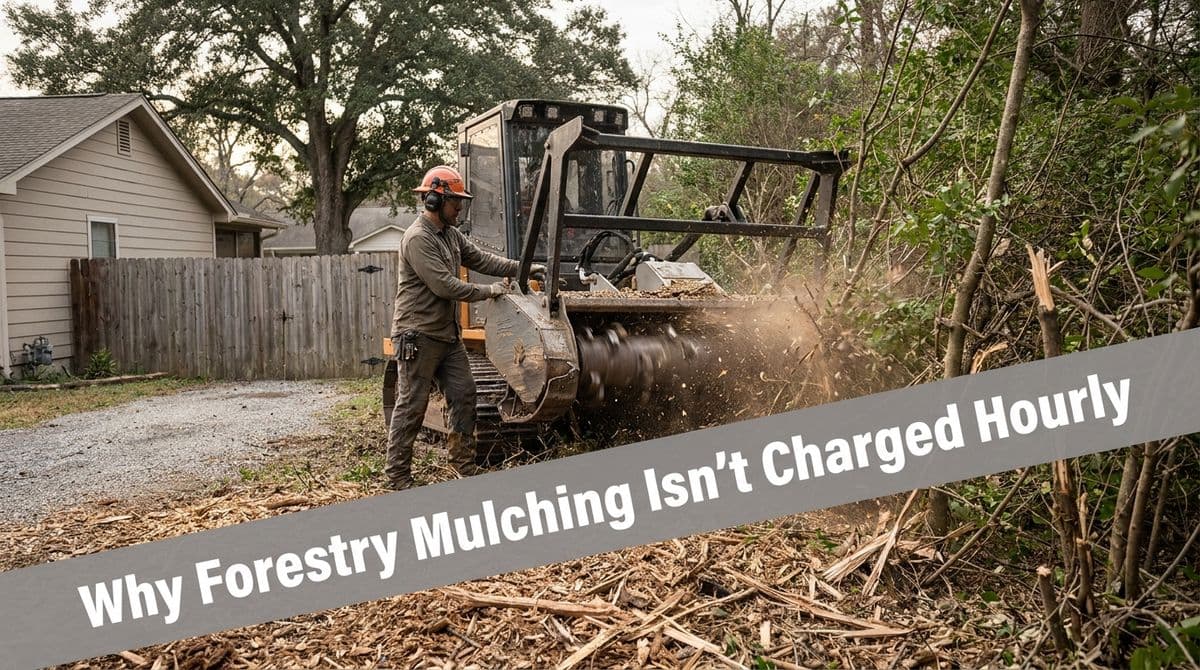
Why We Don’t Charge Forestry Mulching by the Hour
We recently got a call from a homeowner — let’s call him Mark — who was getting ready to clear a little over a quarter acre for a new home build. His first question was simple: “How much do you charge by the hour for forestry mulching?”
I told him the same thing I tell everyone: we don’t price forestry mulching by the hour. And there’s a very good reason for that — it usually works out worse for the homeowner.
Mark’s situation is one we see a lot: mostly smaller trees under 8 inches, some larger ones that needed to be felled, and a goal of getting the site ready for a new build. Let me walk you through the conversation we had and what every homeowner should know before they clear land for a new house.
Why Hourly Pricing Can Be Bad for Homeowners
When Mark asked for an hourly rate, I explained what we would charge if we did it that way: getting a mulcher and skid steer out with an operator would run around $200 per hour, with a $1,500 minimum.
Then I told him why we avoid that model for forestry mulching projects:
- You pay for downtime. If a hydraulic hose blows, teeth need to be changed, or the machine needs a quick repair, the clock doesn’t care — but you still get billed while nothing is getting done.
- There’s no clear budget. Thick brush, hidden rocks, or soft ground can slow production. On hourly pricing, every surprise is your problem, not ours.
- Speed varies by equipment and operator. A powerful skid steer with the right mulcher and an experienced operator can clear in a few hours what a smaller setup takes all day to do. Hourly pricing hides that difference.
That’s why we price by the project for forestry mulching. You know the cost up front, and we take on the risk of delays and hiccups.
What We Look At Before Giving a Forestry Mulching Price
Mark’s first estimate was “a little over a quarter acre,” but acreage is only part of the story. During our call, I asked the same questions we always do:
- What’s actually on the land? Mostly brush? Saplings? A mix of trees and undergrowth?
- Tree diameter. Mark had “a lot of under 8-inch trees” and a few larger ones. That matters for what we can mulch and what we need to cut.
- End goal. In his case, he wanted the land cleared for a house, with some trees left for shade and aesthetics.
All of this helps us decide what equipment to bring, how long the work should take, and how to structure the project price so it’s fair and predictable for you.
What Our Forestry Mulching Equipment Can (and Shouldn’t) Do
Mark also wanted details on our equipment and capabilities — questions we love.
We typically bring a skid steer with a forestry mulcher attachment, and in some cases an excavator as well. We run high-horsepower units (think top-tier Bobcat or Cat machines) with two main mulching heads:
- Fine-mulch head for a cleaner, more “finished” look with smaller chips.
- Rough-mulch head when you just need it knocked down efficiently and aren’t as concerned about appearance.
Then we talked about tree size. A lot of folks ask, “Can you mulch 8–10 inch trees?” Here’s the honest answer we gave Mark:
- We typically mulch material 6 inches and under.
- Anything over about 6 inches, we cut down instead of mulching.
If someone tells you they’ll just mulch everything over 6 inches, that’s a red flag. It’s hard on the machine, less efficient, and often not the right approach for a building site.
What Happens to Big Trees, Stumps, and Debris?
Mark was planning a new build, so we talked about what happens after the cutting and mulching are done.
For larger trees (over that 6-inch range), we can:
- Fell them and stack logs in a pile for firewood or milling.
- Haul them off-site for an additional fee.
- Stage them for a controlled burn, where allowed by local regulations.
For stumps, especially on a build site, we’re very clear: builders do not want stumps left in the building pad. We typically:
- Remove stumps in areas where foundations, driveways, or patios will go.
- Discuss options like grinding or leaving select stumps out in the yard areas if that makes sense for the design.
We walked Mark through all of this so he could decide where he wanted completely clean ground and where a more natural, mulched look was okay.
Getting Land “New-Build Ready” vs. Just Mulched
One thing I clarified with Mark is that forestry mulching is just one step in getting a property ready to build. We can often take a site:
- From overgrown brush and small trees
- To cleared, mulched, and rough-graded ground
- With stumps removed where future structures will go
After that, your builder (or excavator) still needs to come in to dig the basement or foundation and do any final grading to their specs. But when we say we can take it “all the way to final grade,” we mean we can get your lot to a point where your builder isn’t fighting roots, stumps, or piles of debris.
Typical Cost Factors for Forestry Mulching a Homesite
Every property is different, but homeowners like Mark always want to know what drives the final price. Here are the big factors:
- Size of the area – A quarter acre of light brush costs much less than a dense acre of saplings.
- Density and type of material – Thick underbrush, thorny growth, or lots of small trees take more time than scattered vegetation.
- Number and size of large trees – Felling, bucking, and handling big trees adds labor and sometimes extra equipment.
- Debris handling – Leaving mulch on the ground is cheapest; piling logs, hauling material, or burning adds to cost.
- Finish level – A rough knockdown is less than a fine mulch with multiple passes and tighter grading.
For many small home-site projects, it’s realistic to expect a minimum project cost in the $1,500+ range, with larger or denser sites going up from there. The key is that you get a fixed project price after we walk the property, not a vague hourly guess.
Homeowner Checklist Before You Clear for a New Build
If you’re where Mark was — starting to research forestry mulching for a new build — here’s a quick checklist to help you prepare:
- Mark trees you want to keep. Use ribbon or paint so we don’t accidentally take out a favorite shade tree.
- Know your build footprint. Have a rough idea where the house, driveway, and septic (if applicable) will go.
- Decide on debris handling. Are you okay with mulch left in place? Want burn piles, log piles, or hauling?
- Ask about stumps. Make sure your contractor plans to remove stumps where structures will sit.
- Request a site visit and project price. Don’t settle for an hourly “guesstimate” over the phone.
- Check past projects. Look at photos or videos of their forestry mulching work, not just general excavation.
When Mark was done with his research, we scheduled a walkthrough with our project manager so he could see exactly what to expect, what the land would look like when we were finished, and what it would cost — no surprises, no watching the clock.
Ready to Clear Land for Your New Build?
If you’re getting ready to build and staring at a lot full of brush and small trees, forestry mulching can be a fast, efficient way to get that land under control. Just remember: hourly pricing usually shifts the risk onto you.
Ask for a site visit, a clear scope of work, and a project-based price, and you’ll be in a much better position when it’s time to turn that wooded lot into the site of your new home.